
Both are marketed as thin-film alternatives to classic insulation – yet they differ fundamentally. A factual comparison of technology, evidence and cost.
In the search for efficient insulation solutions away from thick polystyrene boards, you almost inevitably come across two terms: 'liquid ceramic' (also called thermoceramic) and ISORYX's 'Reflection-Barrier-Technology'. Both promise energy savings through thin layers, but the physical principles and the quality of evidence differ significantly. In this technical article, we analyze why mass is not the same as reflection and why many promises of classic thermoceramics reach their limits in terms of building physics.
The Working Principle: Microspheres vs. Reflection-Barrier
Classic liquid ceramics are mostly based on acrylate dispersions mixed with hollow glass spheres (microspheres). The theory behind them: the partial vacuum enclosed in the spheres is supposed to drastically lower the thermal conductivity (the U-value) of the coating. In practice, however, a layer of 1 mm is too thin to offer significant resistance to heat conduction. The effect is measurable, but often not sufficient to replace conventional insulation materials.
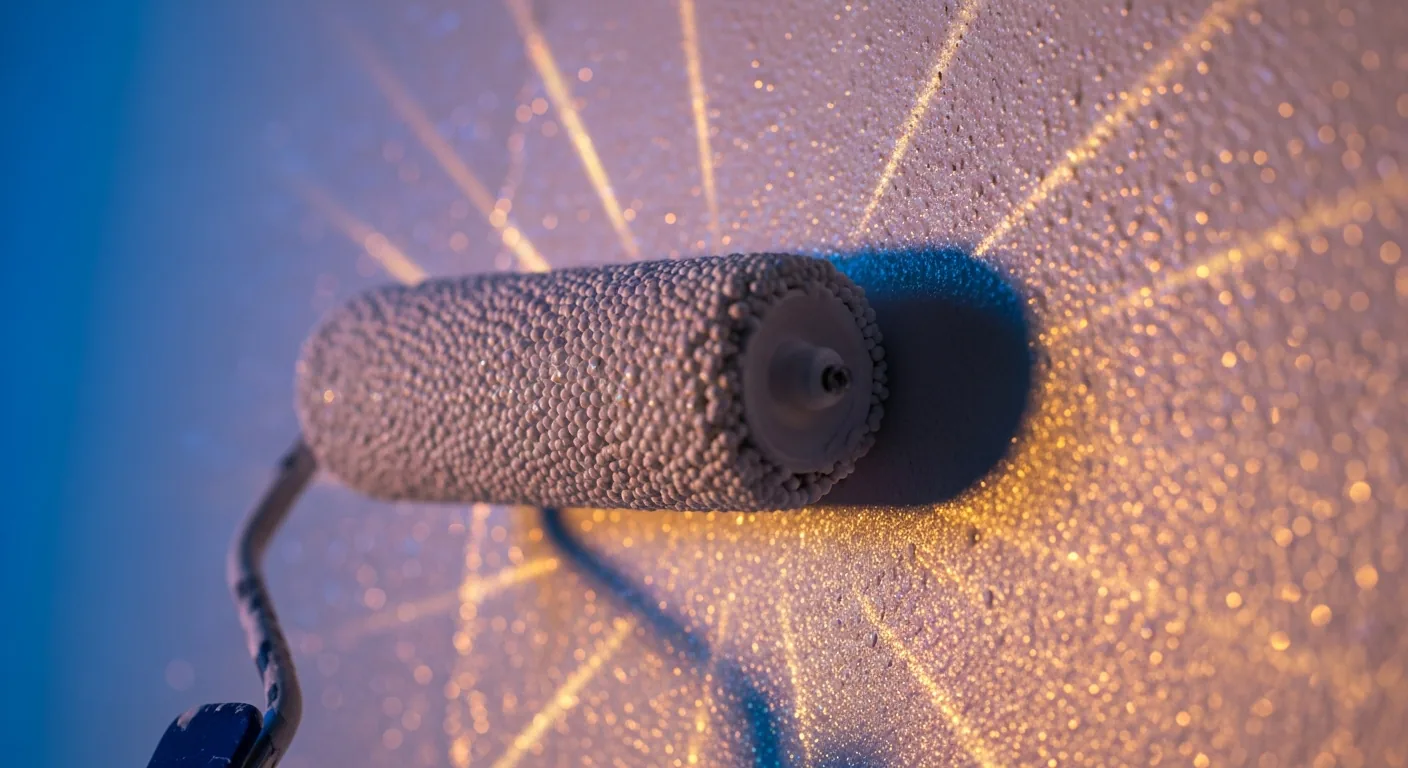
ISORYX, on the other hand, takes a different approach: Reflection-Barrier-Technology relies on a silicone resin base with specialized mineral fillers. Instead of trying to slow down heat conduction, ISORYX reflects over 90% of infrared radiation (radiant heat) directly at the surface back into the room. Since radiant heat accounts for a large part of heat loss, this mechanistic difference is crucial.
Direct Comparison of Technologies
| Criterion | ISORYX | Liquid Ceramic (typical) |
|---|---|---|
| Base | Silicone resin (mineral) | Pure acrylate (synthetic) |
| IR Reflection | > 90 % | 30 – 80 % |
| Layer thickness | 0.4 mm | 0.5 – 3.0 mm |
| Vapour diffusion | Excellent (open) | Moderate to good |
| Fire behavior | Proven (EN 13823) | Rarely independently tested |
| Antimicrobial | Yes (ISO 22196) | Mostly no |
Vapour Diffusion and Moisture Management
An often underestimated factor in building physics is moisture. Damp walls conduct heat up to three times faster than dry ones. Conventional acrylate-based liquid ceramics often form a dense 'plastic film' on the wall. This can hinder vapour diffusion and, in the worst case, lead to moisture accumulation under the coating.
ISORYX is highly vapour-open. The mineral structure allows the wall to 'breathe'. Moisture from the masonry can escape unhindered to the outside (or into the room). The result is a permanently dry masonry, which naturally has better insulating properties. This indirect insulation effect through dehumidification is a core advantage of ISORYX.
Long-term Stability and UV Resistance
Acrylate coatings (many liquid ceramics) tend to become brittle and chalky under UV radiation. The mineral silicone resin base of ISORYX, on the other hand, is extremely weather-resistant. The reflection properties remain stable over decades, while the glass spheres in liquid ceramics can lose their effect over time due to mechanical stress or erosion.
- Higher IR reflection (>90%) ensures warmer wall surfaces in winter and a cooler indoor climate in summer.
- Mineral silicone resin base is extremely weather-resistant and durable (no yellowing, no peeling).
- Integrated protection against mould and algae without excessive biocides through physical drying.
- Lower material consumption: 0.4 l/m² for ISORYX vs. up to 2.0 l/m² for liquid ceramic.
Efficiency and Price
When comparing prices, many customers make the mistake of only looking at the price per liter. However, the price per square meter of finished surface is decisive. Since liquid ceramics often require layer thicknesses of 1.5 mm or more for a measurable effect, material consumption is extremely high.
ISORYX only needs two thin coats (approx. 0.4 mm in total) for its reflection barrier to unfold fully. This means: with one bucket of ISORYX, you can cover three times the area compared to conventional liquid ceramic. Despite the higher price per liter for the high-tech components, ISORYX is unbeatably inexpensive in the overall calculation.
Comparison of Application Areas
While liquid ceramic is often advertised as a 'panacea' for every wall, ISORYX's superiority is particularly evident in demanding scenarios:
- Listed buildings: Where external insulation is not possible, ISORYX offers high-efficiency internal insulation without loss of space.
- Industry: Reduction of radiant heat on tanks and pipes through >90% reflection.
- Mould prevention: Increasing the surface temperature above the dew point without 'sealing' the wall.
We don't sell miracle paint; we sell applied building physics. Reflection beats mass when it is properly certified.— ISORYX Technical Team
Frequently asked questions
Is ISORYX the same as liquid ceramic?
No. While liquid ceramic is based on acrylate and hollow glass spheres, ISORYX uses a mineral silicone resin base and Reflection-Barrier-Technology. ISORYX is significantly thinner, more vapour-open, and has higher IR reflection (>90%).
Why is ISORYX cheaper despite a higher price per liter?
Because of the significantly lower consumption. Liquid ceramic requires thick layers for its effect (approx. 1.2–2.0 l/m²), while ISORYX achieves its full effect at just 0.4 l/m². This saves up to 68% of material costs per square meter.
What is the problem with the acrylate base in liquid ceramic?
Acrylate is a plastic that can 'seal' the wall (low vapour diffusion). This can lead to moisture damage. ISORYX is based on silicone resin, is mineral and extremely breathable, which keeps the wall permanently dry.
Are microspheres (glass spheres) sufficient for insulation?
Microspheres reduce heat conduction only minimally in thin layers. The real lever is the reflection of thermal radiation. ISORYX reflects >90% of IR radiation, which is physically far more effective than the purely conductive approach of thermoceramics.
Is liquid ceramic UV-resistant?
Many conventional acrylate-based liquid ceramics can yellow or become brittle over time. ISORYX uses a UV-stable mineral silicone resin matrix that retains its reflective properties and protective function for decades.
Are there independent proofs for ISORYX?
Yes. ISORYX has certified test reports according to international standards, such as ISO 22196 (antimicrobial) and EN 13823 (fire behavior). Many liquid ceramics advertise physical 'miracles' without independently proving these standards.
Can ISORYX be applied over existing liquid ceramic coatings?
Yes, after appropriate priming with ISORYX Primario, this is usually possible. It improves the energetic properties and provides a vapour-open, mould-resistant surface.
Does ISORYX reduce living space like classic insulation?
No. With a layer thickness of only 0.4 mm, your living space remains completely intact. This is one of the biggest advantages over conventional insulation boards (ETICS/WDVS), which are often 10–20 cm thick.